


Crossing the borders of European countries is becoming easier because to the dozens of train routes that have been established recently.
A considerably more ambitious plan for the continent’s train connections, however, was recently unveiled by a think group based in Copenhagen.
The plan for 21st-century Europe calls for the construction of a high-speed rail network that would operate similarly to a metro or tube system throughout the continent.
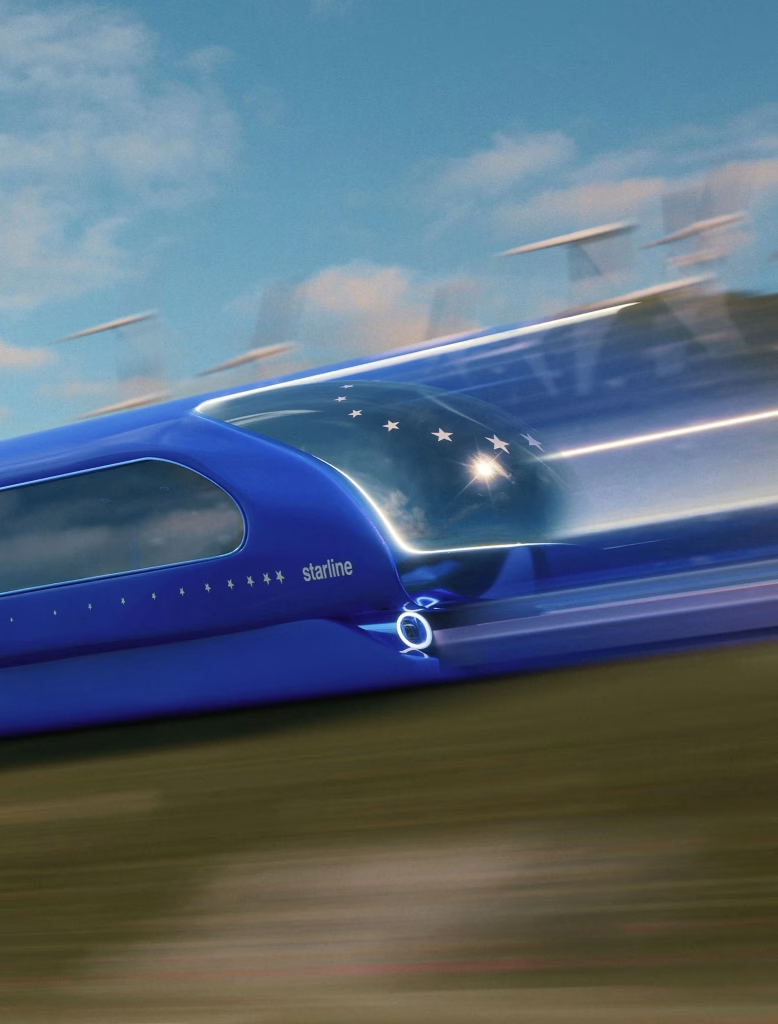
With the name Starline, it aims to modernize the “fragmented, uneven, often slow” train system across the continent and offer lightning-fast connections to compete with air travel.
The think group claims that “a truly integrated rail system is no longer just a matter of convenience; it’s a strategic necessity for Europe’s resilience in the 21st century.”
“[Starline] transforms the way Europeans view their own continent by transforming it from a collection of far-flung capitals to a single, swiftly-moving network where all connections, whether for people or goods, are easily accessible.”

By 2040, 21st Europe hopes to have the network operational, but how feasible is that goal?
Travelers would undoubtedly love a rail system that runs throughout Europe.
According to the think tank, “the desire for open, accessible travel is clear from the golden age of night trains to today’s 400,000+ Interrail users annually.” “Yet, cross-border travel is still dispersed, costly, and slow despite public demand.”
The European Union is already working on a project called the Trans-European Transport Network (TEN-T), which intends to standardize infrastructure throughout the continent.
However, 21st Europe claims that it lacks “ambition and design” in the “missed opportunity to make rail a defining feature of Europe itself,” as well as in the passenger experience, where “complex ticketing, inconsistent service, and outdated stations make rail feel fragmented.”
According to the group, a cross-border network’s key is a uniform design.
Regarding the current system, it states that “trains vary greatly in design, stations feel disconnected, and the journey itself is rarely considered as part of the experience.”
“Other modes of transportation, such as Scandinavian airports and Japanese bullet trains, have demonstrated that mobility can be both iconic and functional.”
On the 21st, Starline trains could travel from Helsinki to Berlin in five hours. The goal of Europe’s 22,000-kilometer Starline network is to link 39 locations throughout the continent, with lines also going to the UK, Turkey, and Ukraine.
With trains running at 300–400 km/h, the new system is expected to be 30% faster than the current rail and road routes.
In contrast to the current full-day travel, passengers might arrive in Berlin from Helsinki in little over five hours.
According to 21st Europe, Starline would need standardized labor agreements, technical standards, and safety laws in order to operate as a European system.
“This implies that regardless of where they work, train operators, maintenance teams, and station employees would all receive training under a common European framework, guaranteeing operational consistency.”
Although it is a very ambitious plan, the think tank thinks it can be implemented by 2040.
It states, “At this point, we start establishing the network to advocate for substantive change, uniting legislators, designers, and business executives to translate our vision into reality.”